
Concreting In Helston
Concreting Experts
Concrete foundations, oversite slabs, block work and structural concreting across Cornwall. 12 years experience.
12 Years' Experience
Full Plant Fleet
100% Word of Mouth
RW Groundworks
Concreting and Foundations in Cornwall
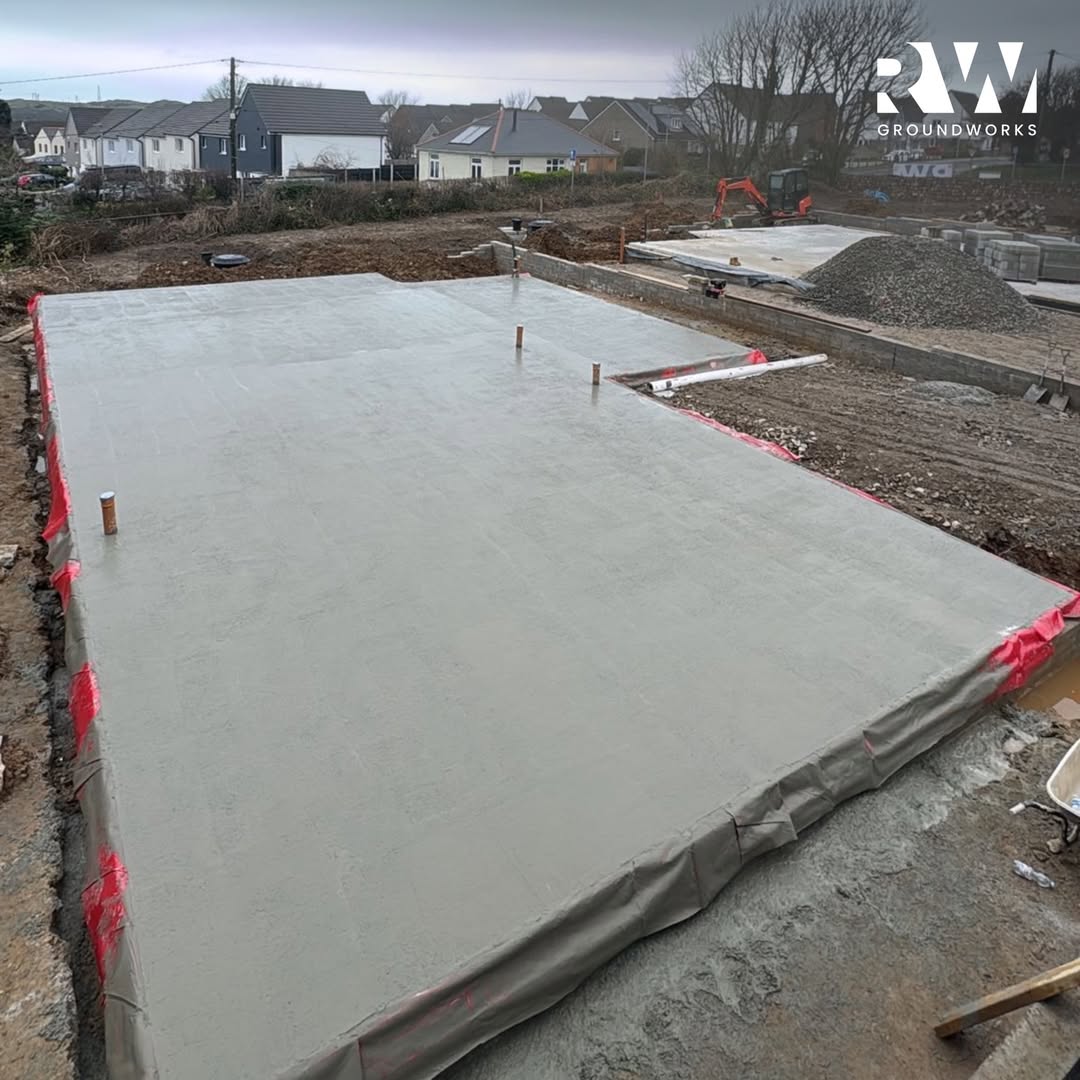
Every building starts with what goes into the ground. If the concrete foundations aren't right, nothing above them will be either. Looking for a CSCS-carded concreting team with their own plant fleet in Cornwall? RW Groundworks delivers structural concreting across the county — foundations, oversite slabs, retaining walls and block work — for homeowners, builders and developers who need it done right first time.
Reuben Williams has been laying foundations for over 12 years. We're currently running groundworks packages on 11 houses for two separate clients, which tells you the scale we work at. But we handle domestic extensions and garage bases with the same approach — dig to the right depth, pour to the right spec, build to Building Regulations.
We work across Cornwall from our base in Helston.
What we do
Our Concreting Services
We handle every type of drainage work you're likely to need — residential, agricultural and commercial. Here's what we cover:

Strip Foundations
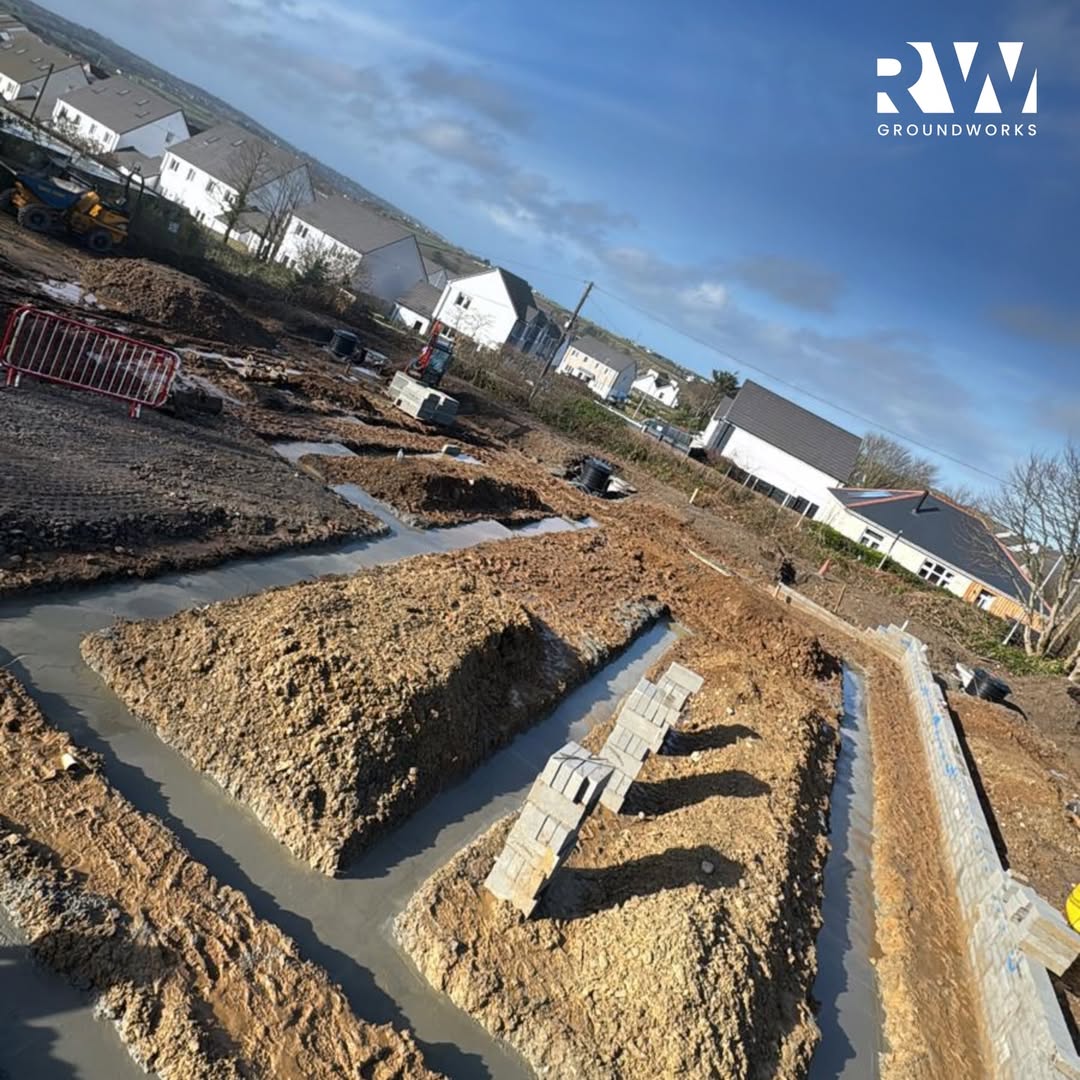
The standard foundation for most domestic builds — a continuous strip of concrete in a trench, with block work built up from it. We excavate to the depth specified by Building Control (typically 1 metre minimum in Cornwall due to clay subsoils), pour the concrete, and build the block work to DPC level.

Trench Fill Foundations
Where ground conditions are poor or depths exceed 1.5 metres, trench fill is often more practical. The trench is filled with concrete to within 150mm of ground level, eliminating the need for deep block work. Faster to build and often the most practical choice on difficult sites — fewer materials, less labour, and no deep block work to price.

Oversite Concrete Slabs
Ground-bearing slabs for new builds, extensions and commercial units. We install the sub-base, DPM, insulation and reinforcement mesh before the concrete pour. All to current Building Regulations standards including thermal requirements.

Concrete Bases
Bases for garages, outbuildings, workshops, log cabins and garden rooms. We prepare the formation, lay the sub-base, set up formwork and pour to a level finish. If you need power floated or tamped finishes, we handle both.

Block Work
Many block work contractors only lay blocks. We do the full package — foundations, block work, and everything in between. Cavity walls, single skin, retaining walls, and substructure block work up to DPC level. All built to specification with the correct mortar mix and wall ties.
Retaining Walls
Concrete retaining walls for changes in ground level — garden terracing, boundary walls, and structural retaining on development sites. We design for the loads involved, install proper drainage behind the wall, and build to the height and specification required.
RW Groundworks
Concrete Foundations for Every Project
Whether you're building a single-storey extension or a row of new homes, the foundation design needs to match the ground conditions and the structural load. Cornwall's geology varies — granite, slate, clay and made ground all behave differently.
We work with structural engineers and Building Control to ensure the right foundation type and depth for your site. If trial holes or soil investigation is needed, we handle that too.
Our current workload includes foundation packages on 11 residential units, so we're set up for both volume and precision. Same team, same standards, whether it's one garage base or a full housing development.
RW Groundworks
Why Choose RW Groundworks for Your Concreting
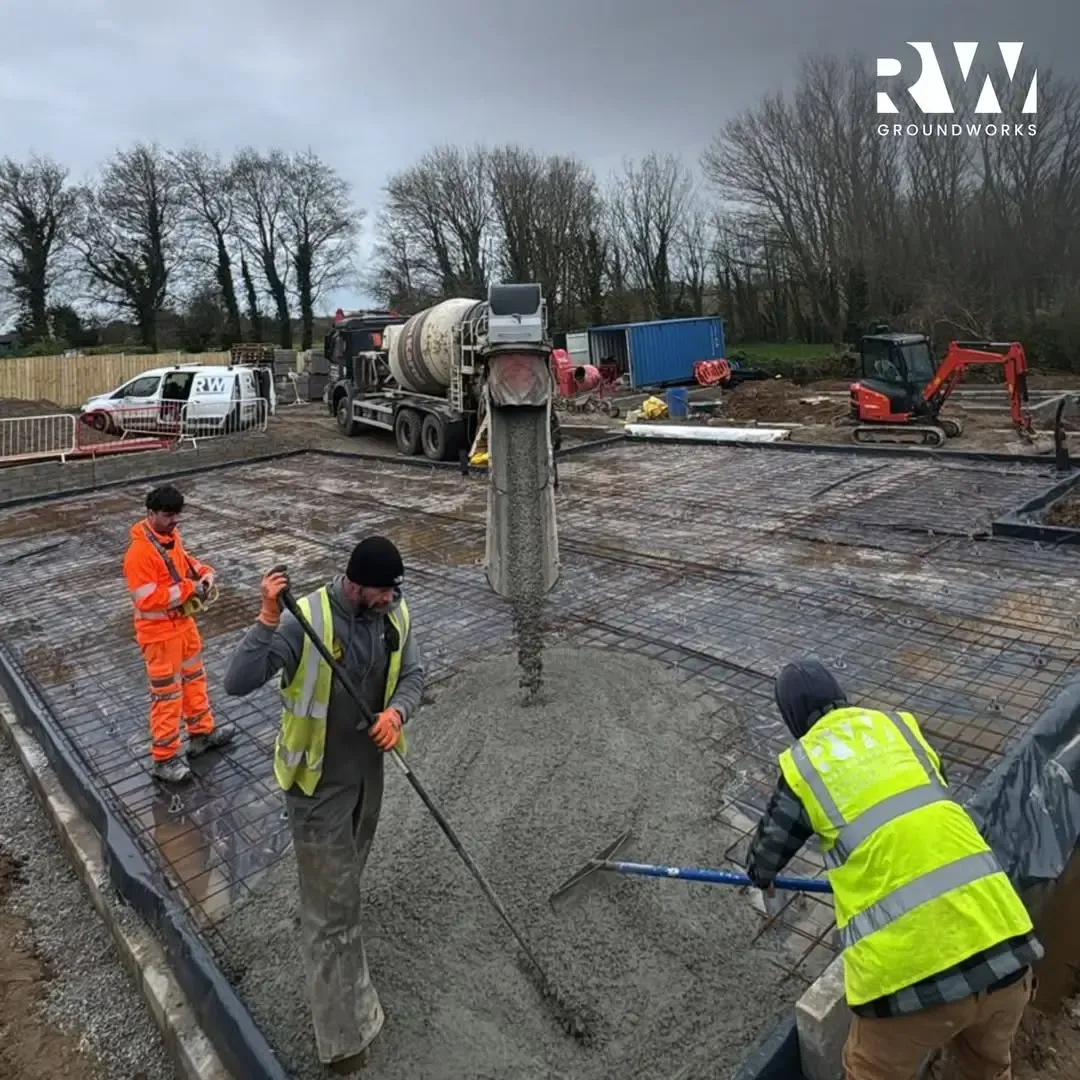
Full Plant Fleet — 14T Doosan excavator, 3.3T Hitachi, 7T dumper, rollers and compaction equipment. We bring everything needed for excavation, concrete placement and site clearance.
Qualified Team — CSCS cards, SSSTS and SMSTS, and highway operative qualifications. Our team is qualified for regulated sites including highways and commercial developments.
Start to Finish — From excavation through to block work at DPC level. One contractor, one mobilisation, no coordination headaches.
Building Regs Compliant — We build to current Building Regulations and coordinate with Building Control inspections as standard.
12 Years in Construction — Reuben has been doing this since before shortcuts became fashionable. We know what works in Cornwall's ground conditions.
TESTIMONIALS
What Our Concreting Customers Say About Us
The Process
3 Step Process For Your Concreting Needs

Contact Us
Start by completing the 'Get a Free Quote' form on our website to share your Concreting needs with us.

Schedule Your Estimate
Next, we'll arrange a property visit at a time that works for you to provide an in-person estimate for your Concreting needs.

Get The Job Done
After you approve our estimate, we'll schedule a date to complete the job. Our team will work hard to exceed your expectations!
F.A.Q
Concreting Frequently Asked
Questions
Here are answers to common questions about our Concreting services.
Q: How much do concrete foundations cost?
A: Foundation costs depend on the type (strip, trench fill, or raft), the depth, the length of the run, and ground conditions. As a rough guide, strip foundations for a single-storey extension start from around £150 to £200 per linear metre. We provide accurate quotes after a site visit — ground conditions in Cornwall can vary significantly even within the same plot.
Q: How long does it take to lay foundations?
A: A typical domestic extension foundation takes three to five days — excavation, concrete pour, and block work to DPC level. Larger projects like new builds take one to two weeks for the substructure phase. We coordinate with Building Control for inspections to avoid any hold-ups.
Q: How deep do foundations need to be for an extension?
A: Building Control typically requires a minimum of 1 metre in Cornwall, but this can be deeper if you're building near trees, on clay soil, or on sloping ground. The depth is determined by ground conditions, not by rule of thumb. We dig trial holes if there's any uncertainty.
Q: What types of foundations are there?
A: The main types are strip foundations (concrete strip with block work), trench fill (trench filled with concrete), raft foundations (reinforced concrete slab), and pad foundations (for steel frame buildings). The right choice depends on your ground conditions, the building design, and Building Control requirements. We advise on the most suitable option for your ground conditions and budget.
Q: How long does concrete take to cure?
A: Concrete reaches working strength in about 48 to 72 hours in normal conditions, but full design strength takes 28 days. We plan our programme around curing times so block work and backfilling happen at the right stage. In cold weather, we take precautions to protect fresh concrete from frost.
Q: How much does a concrete slab cost per square metre?
A: A ground-bearing concrete slab with sub-base, DPM and mesh reinforcement typically costs between £60 and £100 per square metre, depending on thickness and specification. Power floated finishes are at the higher end. We quote based on the actual specification rather than averages.
Q: Do foundations need Building Regulations approval?
A: Yes. All structural foundations require Building Regulations approval. This means a Building Control inspector will check the excavation depth and ground conditions before concrete is poured, and inspect the block work before backfilling. We coordinate these inspections and ensure everything is compliant before we pour.
Q: What happens if the ground conditions are poor?
A: Poor ground — made ground, peat, high water table, soft clay — doesn't mean you can't build. It means the foundation design needs to account for it. Options include deeper foundations, trench fill, piled foundations, or raft foundations. We assess ground conditions on site and work with structural engineers where needed to find the right solution.
RW Groundworks and Civil Engineering Limited


Request A Free Concreting Quote
Get Free Quote


CONTACT INFORMATION
SERVICES
SERVICE AREAS
OPERATING HOURS
Office Hours:
Mon to Sun
9:00am - 5:00pm
Cleaning Hours:
24/7
Privacy Policy | Term & Condition | FAQ
Copyright © 2026 RW Groundworks. All rights reserved.